
Tamer also works on developing a Case Management System and community referral networks: a network in the northern West Bank, and an active, strong network in Gaza. This system is not based solely on individual intervention, but on building a clear path: Identification/Investigation – Initial Assessment – Referral – Follow-up, while maintaining confidentiality, dignity, and the best interest of the child. This includes:
1. Awareness of Protection Risks: Raising the awareness of children, youth, and caregivers regarding concepts of safety, boundaries, violence, exploitation, and bullying, in a manner appropriate to age and context.
2. Positive Parenting: Meetings and materials that help parents build a less violent and more listening-oriented relationship: How do we set boundaries without breaking the child's spirit? How do we see their behaviors as messages rather than provocations? How do we alleviate the impact of pressure on the home?
3. Training Partner Staff and University Students: Training workers in partner institutions and integrating university students into training tracks covering:
- Child protection principles.
- Identifying danger indicators and safe investigation.
- Referral mechanisms and handling disclosures.
- Psychological First Aid (PFA) as an immediate humanitarian response that protects the child from collapse and opens the door for specialized support when needed.
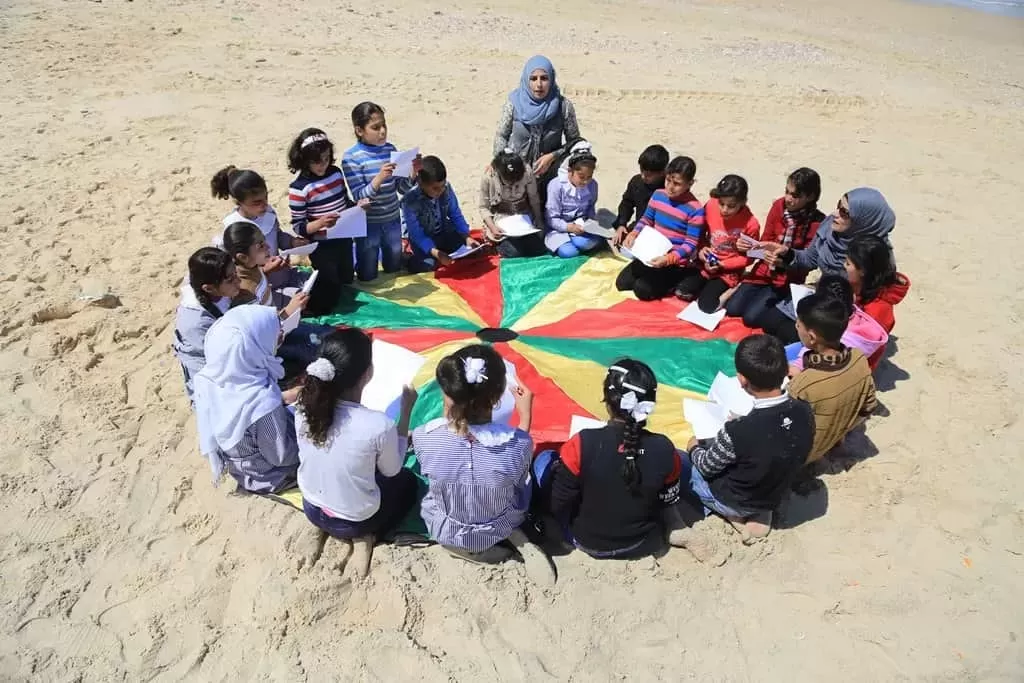
4. Psychosocial Support through the Arts (MHPSS/PSS): Individual and group sessions and venting/expression activities, because protection is not a "report," but a relationship, time, and the use of the appropriate tool.
5. Emergency Response: In times of war and displacement, the library, tent, or corner transforms into a cultural sanctuary: storytelling sessions, collective drawing, puppet theater, movement activities, and educational kits.
6. Documentation as a Protection of Memory: When children’s lives are subject to erasure, documenting their productions (with sensitivity and safety) becomes part of protection. When a child sees their impact acknowledged, they are strengthened. When their experience is transformed into knowledge or art, it becomes part of the collective voice that rejects symbolic erasure.
Why Do We Link Protection to Culture?
Because protection that does not recognize the human being as a creature of meaning—who thinks, imagines, and creates—turns into mere procedures. Protection that recognizes the child as a partner produces a society better able to persevere and more capable of collective healing. Tamer believes that the story is not a luxury, but a soft shield that protects memory. Every storytelling session is a small act of healing, and every book that emerges from the rubble is a promise of continuity.
Tamer’s philosophy of protection is, in simple words: "We protect children with imagination, making them our partners in expression, learning, reading, writing, and drawing." Thus, their individual productions become an affirmation of their existence as an essential part of our collective narrative.