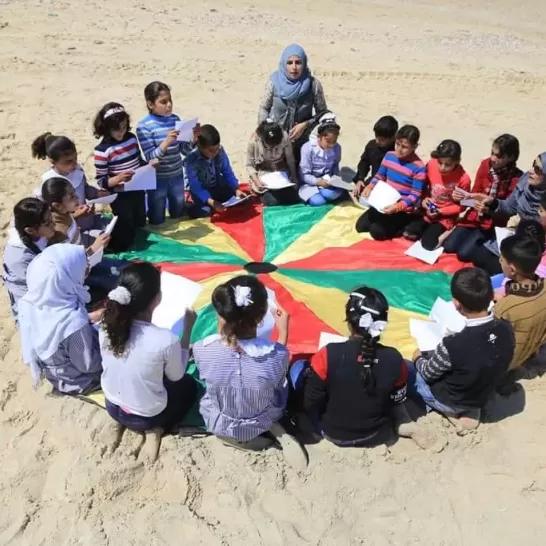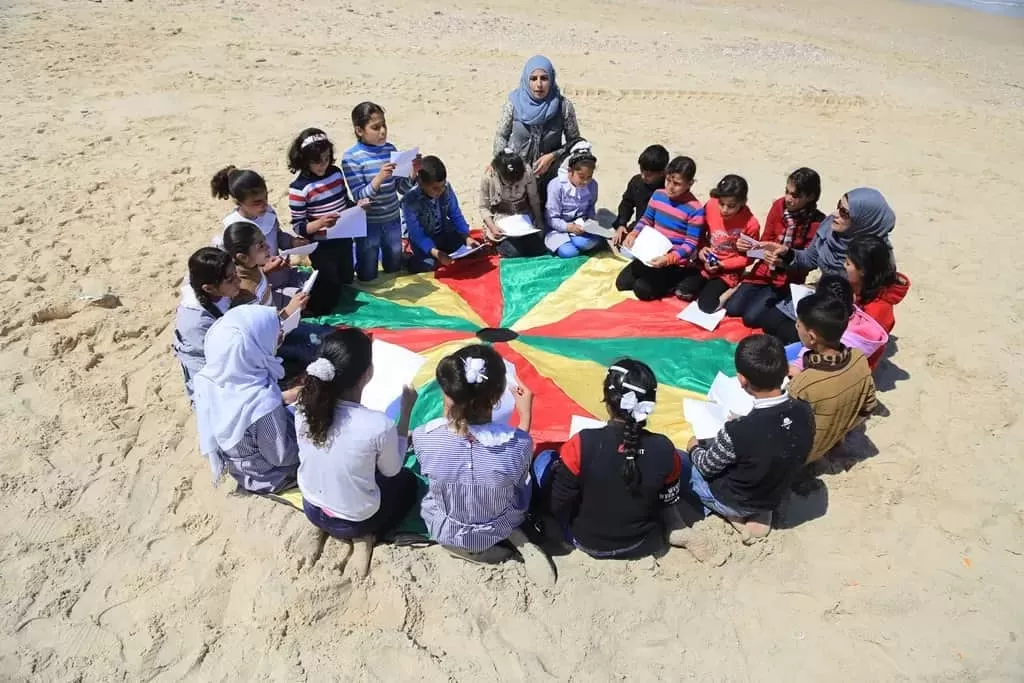
The concept of protection at Tamer Institute emerged with the Institute’s launch in 1989, following the forced political circumstances to which the official Palestinian education system was subjected. This triggered the need to create community alternatives to protect children's rights to education and natural cognitive growth through the Institute’s programs and interventions, which are both foundational and adaptive. The national reading campaign, the publishing unit, and the network of children’s literature libraries along with the rest of the Institute’s units, serve as the structural cornerstones of the Institute’s mission. Within its institutional trajectory, these units have functioned as vital instruments for the holistic protection of childhood, ensuring that intellectual growth and creative expression remain safeguarded.
The Institute’s learning approach focuses primarily on protecting children's experiences within education systems and the necessity of bolstering these experiences with intellectual foundations that enable children to address their various personal and social issues based on analytical and critical thinking skills. This contributes to creating generations that are aware of their social, political, and cultural reality, and capable of moving toward building their future.
The Institute’s learning framework prioritizes preserving the integrity of children's experiences within formal education systems. It emphasizes the necessity of fortifying these experiences with critical foundations, enabling children to interrogate and navigate complex personal and social challenges. By fostering analytical and critical thinking, this approach cultivates a generation that is not only deeply attuned to its socio-political reality but also empowered to proactively architect its own future.
The 2014 aggression on Gaza constituted a critical turning point, imposing major challenges given the scale and nature of the damage, and necessitating a profound evolution in the Institute’s protective framework. In response to the unprecedented scale of the crisis, Tamer integrated specialized Case Management methodologies into its existing community-based programs. This strategic orientation synthesizes decades of institutional legacy with contemporary humanitarian standards, fortifying the Institute’s capacity to address individual vulnerabilities while maintaining its core vision of nurturing growth and critical learning within volatile environments.